Design & Manufacture: MSS SP-71 (Class 125 Iron Body Check Valves)
Face-to-Face: ANSI B16.10
Flange End: ANSI B16.1 (Class 125)
Pressure Test: MSS SP-71
Description
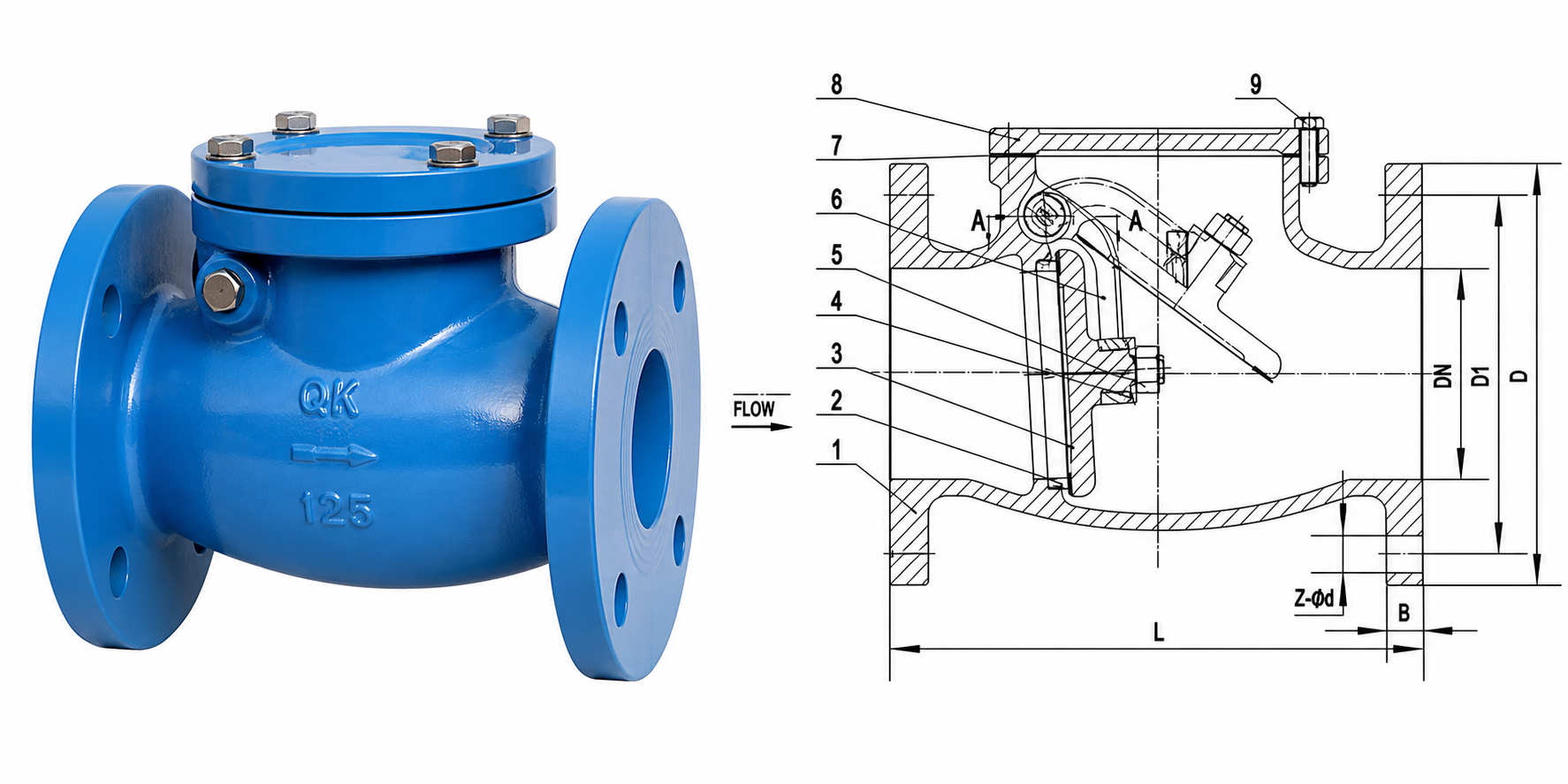
The ANSI Cast Iron Swing Check Valve is a robust, Class 125 (200 CWP) non-return valve designed to prevent backflow in piping systems. Constructed from durable ASTM A126 Class B cast iron with bronze trim, it features a bolted bonnet for easy maintenance and a renewable seat design. The valve automatically closes when flow reverses, ensuring system protection. It is suitable for installation in horizontal pipelines or vertical lines with upward flow.
Technical Specifications:
Nominal Size (NPS): 2″ – 24″ (DN50 – DN600)
Pressure Rating: Class 125 (200 CWP)
Steam Capability: 125 psi (8.6 bar) saturated steam up to 353°F (178°C)
Applicable Medium: Water, Oil, Saturated Steam
Suitable Temperature: -29°C to 178°C (-20°F to 353°F)
Main Parts & Materials:
Parts Name
Materials
Body, Bonnet
ASTM A126 B
Disc
ASTM A126 B
Stem
SS420
Seat Ring
Brass
Key Product Features:
Renewable Seat & Disc: Features a renewable seat pan and an iron disc with a bronze disc face ring, allowing for easy maintenance and extended service life.
Bolted Bonnet Cover: The bolted bonnet cover facilitates convenient access for inspection and maintenance of internal components.
Bronze Trim: Equipped with a bronze seat ring (inlay) to ensure a tight seal and resistance to wear and corrosion.
Steam Capability: Rated for 125 psi (8.6 bar) saturated steam up to 353°F (178°C).
Reliable Sealing: Utilizes a synthetic fiber gasket for the bonnet to ensure a secure, leak-free seal.
Precision Machining: Precision-machined components guarantee optimal performance and dimensional accuracy.
Application Note: Not suitable for reciprocating air compressor applications due to potential pulsation issues.
Applications:
Ideal for Municipal Water Distribution, Steam Distribution Networks, Oil Pipelines, and General Industrial Fluid Systems. Specifically suited for horizontal pipelines or vertical lines with upward flow where preventing reverse flow is critical to system safety.